2014-08-14

"Facepalm" or Sometimes, you just gotta wonder: 'What was I thinking?'


There are two adages that I’ve heard over the years I’ve been photographing; there are many more, these are apropos to this post.  I remember reading in some book on technique:  
“If you’re walking forward, turn around and look backwards.”
 and hearing at a photography seminar: 

“Review your rejects. You just may have overlooked something in those contact sheets.”
I’d finished the edits of my Toronto trip and was at a bit of a loose end. It was late at night in the OCC and I had my laptop with me and noticed that I had this folder in Lightroom called “Uncataloged”.  I remember that I had done some work there, but for the life of me I couldn't remember what. Stepping through the Lightroom catalog in a kind of desultory fashion, not really looking directly at the images but seeing them out of the corner of my eye I was looking for something to jump out at me. They say that if you want to see an animal, you’d see it best by not looking straight at it, especially if it was hidden. Although this is best for detecting motion, it was late in the evening and I wanted to see what would pop out of the thickets.

About half way through, I came up on two images. The first had me doing the proverbial facepalm. I had given this image one star and for whatever reason it never progressed further. I don’t know why. Other images did rank higher and may be slightly stronger; this image is, in retrospect, strong as the others. 


It was early April when I made this image. I do recall turning and reacting to this “homme d'affaires” striding through spring sun. I had metered on the sidewalk earlier and as I turned to look back, there he was. In post, I cropped a bit and then ran the image through SilverFX.

A little later, I ran into an image made about seven month earlier. Again it was one of those where I had metered on the sidewalk and turning around and looking backwards to where I had come from, there she was on her bicycle. Those of you who know Calgary, will know that this street corner is usually quite packed with traffic and yet here she is, serenely cycling on a September afternoon.

I can understand why maybe this one ended up on the cutting room floor as the woman is slightly out of focus. I cropped and straightened things out a bit and again ran the image through SilverFX. 

Always turn and look, you never know what is going on behind you. Turn back the pages and look at what you’ve discarded. You’re a different photographer today than you were yesterday, last week, last month. Go back a year and you’ll see how your sensibilities have changed and that dog of a photo may just be the one that shouldn't have gotten away.

New on the Bookshelf


I love books about photography, books of photographs and books about photographers. Reading other photographers insights into the craft, criticism of the craft, deconstructing other photographers images all help me on this odd journey that I'm on. Unlike some photographers, I don't have GAS, I suffer from BAS!  In the past month or so lots of new books have arrived on my desk. I might comment on some of them more formally in the future. (The books with a * next to the title are in process of being read, the books with a # next to them have been read)

  • *"Road to Seeing" by Dan Winters. A massive book, wonderfully printed, chronicling the events in Winters' life that had an impact on how he views photography and his image making process.
  • #"Here Far Away" by Finn Thrane, Images by Pentti Sammallahti. I'm always on the look out for books by photographers of other nationalities. Again, a wonderfully printed book and Sammallahti are fascinating to study.
  • *"The Digital Print: Preparing Images in Lightroom and Photoshop for Printing" by Jeff Schewe. An excellent resource and I've learned an amazing amount already.
  • *"Why Photography Matters" by Jerry L. Thompson. A slim volume of less than 100 pages. It's one of the few books I started re-reading the day after I finished it. Commentary coming soon.
  • *"Believing is Seeing" by Errol Morris. Examines the back stories to photographs such as Fenton's "Cannonballs in Crimea" and examines the"received wisdom" regarding the photos.
  •  #"About Looking" by John Berger. Although I don't care for Berger's Marxist theory of criticism, at least he's honest about it and doesn't come across like a clever boots like Sontag.
  • #"Understanding a Photograph" by John Berger; Edited by Geoff Dyer. See above
  • #"Ways of Seeing" by John Berger. Neatly kicking Sir Kenneth Clarke's traditional view of European art in the groin, it's a companion book to his BBC series from early 70's. The series is up on YouTube and the book and series is worth a read/look. It's available at Amazon, I found my copy in a used book store.
  • "Camera Lucida" by Roland Barthes. I've been beating my head on this one for over a year. I will get through it one day, honest. Even if takes a bottle of Absinthe!
  • *"Aperture Magazine Anthology - The Minor White Years" Edited by Peter Bunnel. Interesting read to be sure. Looking back at the issues facing photographers in the 50s, they're not all that different from now in reality. The advent of relatively inexpensive high performance cameras where bringing a lot of amateurs into the professional ranks, undercutting them on price for portraits, weddings and the like. Sound familiar? Articles by some of the great photographers and photo editors of the time on composition, captioning, photo critique and the like are a very good resource and refresher.
My son went on an exchange program to Japan and brought me back these two jewels. Both are beautifully printed on heavy paper. If you can find them, they are a delight to look at.
  • "Ephemeral Dreams - Building 30 on Battleship Island" by Masashi Takahashi. Photos of an abandoned industrial island off the shore of Japan. The book takes images from 1972, just before the island was abandoned to images taken this year.
  • "Sleeping Beauty" by Shozo Maruta. Very interesting collection of images of old Japanese street cars rotting away.   
Once these are read, I'll be diving into the reading lists that MIT has provided with their photography course outlines.


2014-07-23

Riding the Rocket

"Riding the Rocket" is probably the easiest way to get around Toronto, once you have overcome the usual barriers to access that are thrown in the face of tourist transit users everywhere. When I first went to Tokyo (which made it easy for us gaijin) a colleague dragged me out of the hotel  to learn the Tokyo subway system. His thing was that if you can figure this the subway systems as soon as possible, no matter where you are, you are independent and won't get extorted by cab drivers. I don't know if the fact that he was Parisian had anything to with it, but going subway navigating is one of the first things I do when I get to a metropolis.

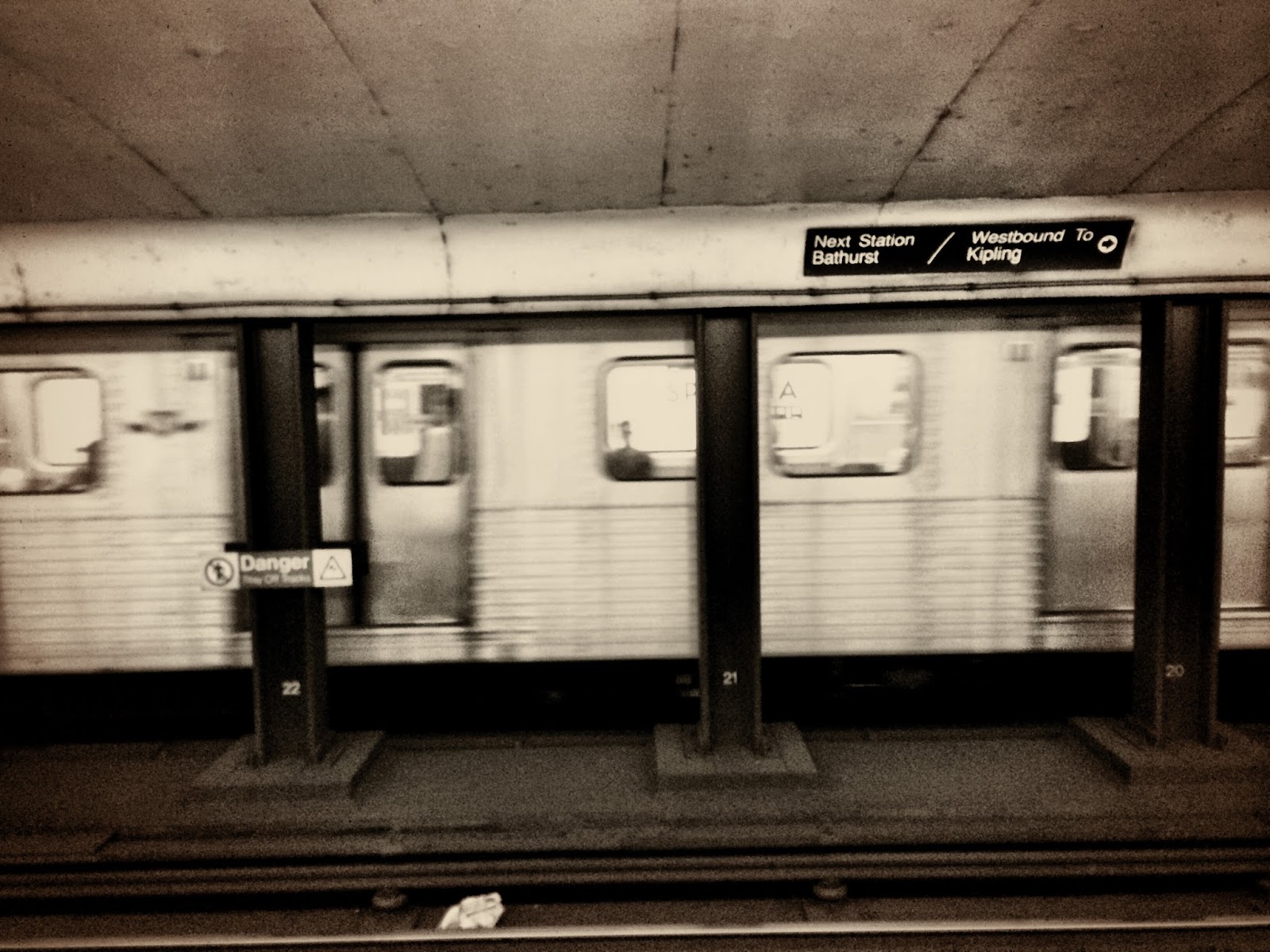
Sitting in a subway car can be a fascinating source of images but most subways have admonitions about photographing on their property. Camera phones have improved to the point now that you don't need to hide a bulky camera underneath an overcoat with a remote release like Walker Evans did. You just look intently as if you are reading a Facebork post and click, there you are. Now, I'm no Walker Evans; I did have a lot fun making these images though.

I've really come to like Camera+ on my iPhone. I've been using since I got my first iPhone three years ago: exposure compensation, movable focus and exposure points, great built-in post processing. It's my go-to app and the reason why I didn't switch to Android when I had to renew my cellphone.

Riding the Bloor-Danforth line the cars lined up and framed in a window was this young woman in intent conversation.
Passing Conversation
I've got this thing for a band called "The Shuffle Demons". So, of course while I was in Toronto I did walk along Spadina Avenue, looking for Bus 77B on the TTC. Never did find it. I did however "get confirmation of my information about my transportation to Spadina Station".
Spadina Station
One trick I used was to place the camera up against the window and click as the station pulled into or out of a station.
Waiting for the Rocket
Facebooking
Ghost In the Machine
I don't think this image would have even worked with anything but a phone camera. This is the operator's ready room at Eglinton Station. There was a screw up (according to the drivers) and the conversations where getting fairly heated. The supervisor (with the white cap) was going toe to toe with a driver and a shop steward, while the other drivers where waiting to see how things would turn out, lobbing the occasional mortar round at the other supervisor.
Union Meeting
You could ride the Rocket for days and never run out of material; you slice through a city from one end to another and get a real sense of the rhythm of the place. Next time more time to be spent on the street cars, and dammit, I will ride on the 77B of the TTC!

People Come, People Go

One thing that is a certainty in the aviation business, especially a charter operation, is that pilots will always move on. Usually it's because they're chasing bigger, faster aircraft with the hope of ending up at a mainline carrier.

I seldom "play requests" as I shoot for myself but one of our pilots is leaving to fly a 737 after several years at North Cariboo and he asked me to make a few images next to the aircraft he flew while he was here. He was a close a friend as you can get in this gypsy industry so I said sure.

I shot the usual but as we were finishing up he walked over to get the prop ties and engine plugs. I turned and saw him walking into the sun. One shot was all I had.

Goodbye
See ya buddy. It was a delight working with you. Hope to work with you again.

2014-07-04

Conversation and Communion


Granville Street February
I was in Vancouver earlier this year for a break from the "maximum effort" flying that is so common for our charter operation during the winter. A typical Vancouver February: watery sun, flat light and on my last full day, fog, misty rain and a cloud deck that aviators would call VV001. 
 
I grew up in many places in British Columbia, but Vancouver was one like a perihelion for my family's orbit around the province as the government of the time was pulling the transportation infrastructure into the twentieth century. Every city has a DNA and no matter what sort of urban renewal happens, if you scratch deep enough you'll find it. When I get into Vancouver I still feel, like Commander Vimes, the cobbles through the soles of my shoes even if where the Cafe Heidelberg once was there no stands a glitzy temple to trendy fashions. 

Evenings in Vancouver are special, no matter what time of year. The streets always have something going on - unlike Calgary where it's a stampede out of the city to the suburbs leaving the hivemind empty save for the immigrant cleaners tidying up after a day’s hard free enterprise. Just standing on a corner gives you boatloads of ideas and images.

While I was out walking a small idea for a project started to glimmer in my mind; I noticed that everywhere people were huddled close together in conversation over food. In groups of two, three and more people laughed, flirted, argued, wept.
Don't Cook - Just Eat

Diner Date

Specials

Looking at the take from the two evenings I saw something else. The interaction between the service people and food truck operators was a similar to the interaction between priest and communicant. Makes sense, Communion does commerate a meal.
Priestess

Waiting for the Host

Of course, not all the priests had communicants. Like one of Pratchett's Small Gods they had few if any adherents, no matter how inviting the chapel
Hot Dog

Pizza, Lasagna, Poutine

And some were excommunicated or never had a small god. Wandering Vancouver's East Side this fellow stopped me. He had an interesting story and we shared a conversation; he gave me two cartoons he had sketched and I gave him some money for a coffee.
Itinerant Cartoonist

Techincal Notes

The usual rig (not that it really matters but some people care): Lieca M-E (Biogon 35/'Cron 50), EP-2 (Olympus 45). All with my usual workflow: Raw conversion and exposure correction in Lightroom, noise reduction and sharpening with NIK and final post with NIK (Viveza/Silver Efex).


2014-04-01

Whatever is She on About? Sontag "On Photography"

I first read about this book while exploring Geoff Dyer’s “The On-Going Moment” and put it, along with books by John Berger and Barthes, on my reading list. It's taken a long time to get to this point and writing this seems to have taken almost as long as reaing the book in the first place.

“On Photography” was first published in 1977 and is a collection of essays written between 1973 and 1977. In it, Sontag explores the force of photographic images which are continually inserted between experience and reality by artists, governments and people who want to sell you stuff. Sontag goes on to develop the concept of ‘transparency’: in a world where anything can be photographed, and photography has removed the standard definitions and boundaries of ‘art’ a viewer can approach a photograph freely without any preconceived notions of what it could mean or even having an expectation of discovering what it means.

I found this an incredibly frustrating book to read. A couple of times I threw it across the table with a: “Really? Really? WTF?”. I would go back and start again. At times I felt like an icebreaker in pack ice: going forward as far as I could, reversing and taking another run at the ice. As one reviewer said: “I'm giving it four stars not for the content itself, but for the quality of thinking I did while reading.” 

Frustrating is her umwelt wherein everything is politicized and the mere act of making an image is compared to a rape, an act of aggression or an act of acquisition. She selectively chooses to ignore the concept of “making” an image choosing instead to speak of “taking” and “shooting”; terms which are, unfortunately, very common in describing the act of pressing the shutter release. I’ve always viewed what I do as a much more gentle process, a totality: making an image is the whole process from seeing the potentiality of something you observe, exposing light sensitive material to the scene and finally developing and printing the resulting image.

Frustrating is her repeated (and tiresome) assertion that consumerism and capitalism requires photography to drive consumer demand. Songtag ignores the fact that the driving of consumer demand through advertising worked quite well with the idealised illustrations you would see on billboards and in magazines and newspapers of an earlier age. Not mentioned at all is the use of photographs in fascist and communist propaganda; these regimes where adept at using photographs to “drive demand” for their particular brand of political philosophy. I’m not even going to comment that it was consumerism that allowed these essays to get published in the first place.

Frustrating is her detestation of the surrealists dismissing them as gadflys and calling them militants. Dali, militant? Off the wall perhaps, but hardly militant. This was one of the times when the book flew across the table, not that I’m an overt fan of the surrealist movement but as a school of thought and art it is worthy of consideration. I find Liebowitz’ portraits as surreal as any work by Dali or Magritte but hey, what do I know. Perhaps some young art student cornered her at a salon. Who knows.

Frustrating are her vehement criticisms of the entire activity of photography, never once pointing out an instance where the creation of an image (in my definition) is a worthwhile pursuit. Trotting out the usual "it's a mechanical process and your're separated from reality by the viewfinder" doesn't wash for me. The act of writing, be it with pen or typewriter is a mechanical process and you are separated from reality by the paper and your mind.

But man, when she nails it, she nails it.

She nails it when she pillories photographic apologists who drone on and on to justify their existence as ‘artists’. This battle, as Berger and Dyer have written, was over a long time ago. Like Toto, she pulls at the curtain exposing the great Oz. I have read too many ‘artist’s statements’ that make my head spin. They seem to be written to a) show how erudite they are, b) appeal to some grant issuing arts council, and/or c) buffalo the ‘arts patron’ in attempt to mystify what is essentially a democratic art form and she calls them on it.

She nails it when she talks about the democratization of photography and how people (dare I say the masses) use it to construct and remember their reality. She actually presages the rise of the selfie and the endless streams of images showing what a person is having for dinner on any number of social network sites. She makes the point that we are relying on images as a proof of reality, the catchphrase and the resulting meme: ‘Pictures or it didn’t happen’ is unfortunate proof of that. At UCLA, the collection of her papers shows a correspondence with Philip K. Dick and I wonder if this is along the lines of “We remember it for you, wholesale”.

The democratization of photography and its impact on the profession and its artistry is not really a new idea. It was already a recurring theme in the ‘50s in the pages of Aperture. If you read “Aperture, The Minor White Years” you’ll see what I mean. Berger notes that once an art form has been democratized, the art establishment or those with the most to lose, will mystify and mythologize the art form in an endeavour to maintain a grasp over it. They create an entire set of incantations and rituals, not unlike a priesthood controlling access to the god viewing those who practice rite or beliefs in their own ways as apostate.

She nails it when she bemoans (in the ‘70s aready!) the “rancorous suspicion in America of whatever seems literary, not to mention a growing reluctance … to read anything,…”

She nails it when she talks about the sloppy, the ill-disciplined: the anti-photograph. Even though she is no fan of photography, what comes through loud and clear is something like this: 
“Look, if you’re going to this, even though I think it's a load of dingos' kidneys, at least do it right. Slapdash is slapdash and you can’t wrap it up with some vapid second rate artist’s statement and pass it off as art.”

She nails it when she talks about photographers returning to simpler technology, eschewing the latest and going back to a beloved camera and lens that they first used in an effort to connect to the craft of photography. We see that trend today, me included. I gave up the all singing, all dancing DSLR and now, although still digital, shoot with a rangefinder. Yes, I still have an autofocus mirrorless digital camera but I use it like I use my rangefinder. I won’t go back to film as I don’t like the stink. I was glad to give up the darkroom for the screen.

Sontag refers to the camera as an “instrument of fast seeing”. The gearhead cult of faster and faster, more and more resolution is being questioned. There is an urge to go back to a more artisanal way, a more contemplative, hand wrought image, an image that had an aura and the imprimatur of the photographer. In fact she references HCB as saying it’s almost too fast now.

In the end, you have to read this book. Love it or loathe it, it will make you think. You have to consider it within the time period that it was written, Watergate, the end of the Vietnam war, global recession and 2nd wave feminism. At times it appears contentious for its own sake, other times you feel written into a corner, presented with a fait acomplii, with no room for further argument. The writing is sophisticated and you can be seduced by “fine well-articulated prose which uses its own music to trick the reader into believing the message” in the words of one reviewer.

Berger in his television series “Ways of Seeing” and in the accompanying book is, to my mind much more honest. Rather than saying:
“I am a very clever man. Here is my ideological construct. I’m much more clever than you so take it as read that I’m right”
he says, (several times in fact):
“This a theory that seems to work for me and explain several things that I have been thinking about. Take these ideas and think about them, accept them or reject them, it’s your choice.”

So, where does this leave me, a non-art student wandering around like a ronin trying to understand his chosen art form? I think it has moved me along a bit on my ronin road.

I’m just a guy who makes images of the world as he sees it, trying to make sense of it, his place in it and maybe use images to tell a story or two. This school or that school, this genre or that genre, colour or black and white, film or digital, this political stance or that one, paper or plastic; it really doesn’t amount to anything in the long run. I’ll just keep trying to share a story, an experience with you and maybe learn a bit about you, me and the world.

I’ll get to Edo yet.

2014-01-03

Backlog IV - The Last Bits


These three images don't really seem to fit in anywhere, yet. When I finished processing my backlog I had a clutch of images that didn't really fit anywhere. Over time these images may find their way into an evolving theme that I don't know that is evolving. 

The first two are tied, somewhat tenuously, by motion. The first one is a bakery at Granville Island. I really enjoyed dancing with the counter staff, reacting to their energy and becoming part of their choreographed motions. 

Our Daily Bread
This field is where Ernest Manning High School once was. It's now just a blasted heath as a result of the Westline LRT in Calgary; I have now idea what the city has in store for it. While I was on leave I had been driving my daughter to school and on the trip home this remnant of what was once a place of learning kept tweaking at me. It kept reminding me of some housing estate in Scotland; all what was missing was DI Rebus.

Finally, one rainy September morning everything came together; I had time, I had my cameras with me and I was feeling just right. I worked the perimters of the field and then as I was crouching down to take a shot of the pathway to the LRT station, these kids came running by; click, click, click. They actually apologized for running into the shot. I wish I could thank them and give them this image as they made the shot.

On the Run
The last one is the last "triste" image I think I'll take for a long time. I'm done with that, I think. I took this just as I was starting therapy and I was a truly emotional low. It was a grey, dull day and I almost didn't go out shooting but I set myself a challenge to make the light work for me. Wandering around the Glenmore Dam I came across a barricade to prevent people from skateboarding on the balustrade along the top of the dam. It's a nothing picture really; yet to me it reflected the barrier I was feeling looking out at the rest of the world.
You Shall Not Pass
With the backlog done, I can start working on projects anew. It was important to work through and reflect on these images as they were taken during a fairly tumultuous time of my life. Now however, it’s time to move on. This coming weekend I’ll be back at my old stamping ground, Heritage Park doing some more infill shooting.

Technical Notes

All of these were with a Leica M-E. The first two were shot using a Zeiss Biogon 35/2.8 and the latter with a Summicron 50/2.0.  Processing was done in LightRoom and b/w conversion done in SilverFX 2.0.